


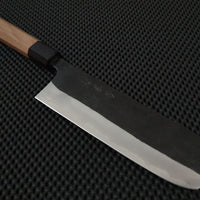
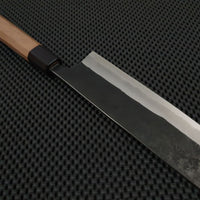
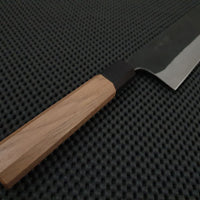
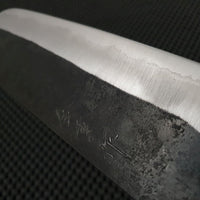
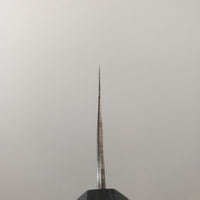
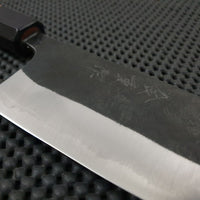
New from Kaneshige, these kurouchi ooze traditional Japanese knives. We've seen many similar looking kurouchi in the past but these have a better grind of a knife of this type. Care may be required however as some have thinner grinds than others.
- Kaneshige Japanese Knife
- Kurouchi (Rustic) Finish
- 170mm Nakiri Knife
-
Aogami (Blue) #2 Carbon Steel - Rustic Grind
- Walnut Octagonal Handle
- Crafted in Japan
- Edge Length: 161mm | Overall Length: 324mm | Blade Height: 53mm | Weight: 185g
- Blade Thickness: (A) 3.5 (B) 2.4 (C) 2.3 (at spine)

* As our Japanese chef knives are hand-made, small variations in size and appearance may occur, and measurements and images are a guide only.
* Care is required to prevent chipping and rust, these are carbon steel.

Japanese Kitchen Knife | Nakiri (Vegetable Knife)
Nakiri knives have a flat profile and tall blade height which aids in push chopping but does make rock style cutting a little uncomfortable. The Nakiri, like many western style chef knives has a double bevel grind, in contrast to the Japanese style vegetable knife, the Usuba, which is single bevel. Whilst a Gyuto or Santoku does do a good job at cutting vegetables, the larger flat bottom of a Nakiri or Usuba make the task much easier. The Nakiri is one of our favourite profiles, highly recommended.
Godammit, ProTooling are the best.
-
A great knife from a good friend of mine. Good knife, hansom chef, the perfect marriage.
-
Chef Rang - Master, Celebrity, Legend

The Japanese are masters of their art and ProTooling are always really welcoming and down-to-earth, willing to spend time finding a knife to suit you.
-
Lennox Hastie - Firedoor
ProTooling offers stunning service & a wide range of amazing quality products. The staff are super knowledgeable, kind & patient, making the selection process very easy. They genuinely care about their products & service, it’s why I keep going back.
-
Anjali - Sous Chef, Saint Peter
ProTooling are unrivalled in product knowledge, knife diversity and above all a burning desire to provide true quality craftsmanship. It truly inspires us as chefs, cooks and craftsman alike to reflect on our own depth of knowledge, skills and industry awareness when surrounded by such informed professionals like ProTooling.
-
Oscar Solomon - GRECA Executive Chef
The team at ProTooling are master at their craft and incredibly kind and helpful while do so! Every time I drop my knives off, I feel a sense of relief as I know how well looked after they are. Love this place and the team - thanks for everything you do ProTooling!
-
Ismat - Recipe Developer / Photo Chef
I have built a very strong relationship with ProTooling. Paul (the owner) has a very good attitude and that reflects in the products he stands behind. He provides only the best quality through all of the good relationships he has been able to grow throughout the years with the top craftsmen in Japan. He and his staff are amazing. Keep up the good work.
-
Nicola - Chef / Knife Connoisseur